One of the world’s smallest
electric boilers
We don’t just claim it. We show you the size, the efficiency and what it costs over 25 years – and you decide.
Building or renovating? Every decision costs money – the bad ones keep costing for decades.
You have to make a long-term heating decision while every installer tells you something different and every manufacturer shows you a different number: one stresses consumption, another the purchase price, a third the output. Every one of those numbers sounds good – they just don’t mean the same thing.
The lowest purchase price is often only the first instalment. The real cost of a heating system is made up of at least six items:
- the price of the appliance
- installation
- maintenance
- repairs and spare parts
- expected service life
- energy consumption
The real price of a heating system is not the purchase price, but everything it will ask of you over the next 25 years – in money, in space and in peace of mind.
A small box that replaces the boiler room
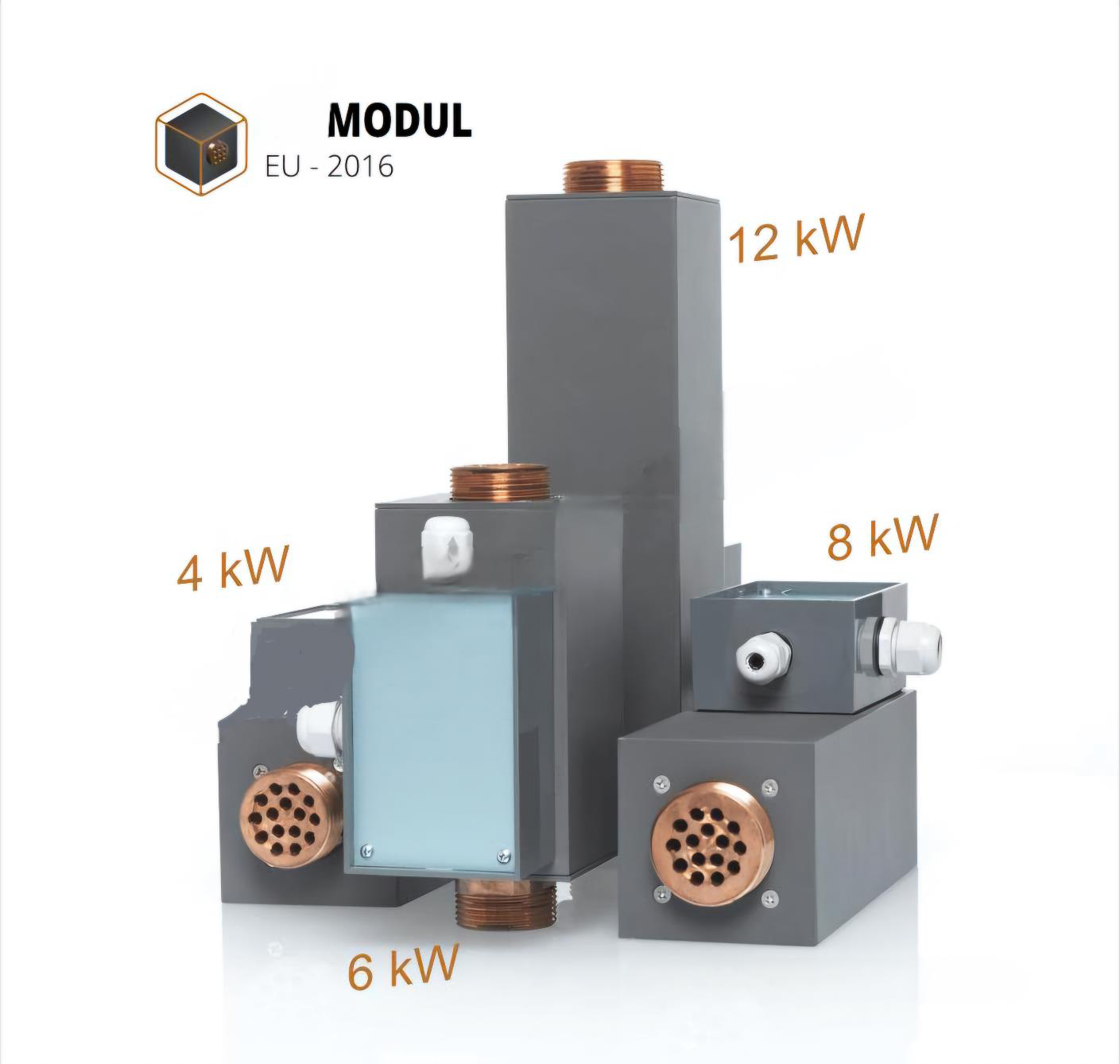
The heating module is an exceptionally small flow-through electric boiler, designed to deliver reliable heat for many years – without unnecessary mechanical complexity. Its heat-transfer surface works at a high heating density, which is why the unit is much smaller than conventional heating-element solutions.
- No separate boiler room or chimney needed
- No gas connection and none of the permits that go with it
- Works with radiators, underfloor, wall and ceiling heating
- Provides domestic hot water too, with an indirect cylinder
- Precise control: ±1 °C
- No moving parts: no compressor, no fan
- Quiet operation
Four outputs
efficiency 99.4%
efficiency 99.5%
efficiency 99.6%
efficiency 99.6–99.7%
Floor areas apply to buildings that meet modern thermal standards; exact sizing is decided by the building’s heat loss. Several modules can be connected in parallel.
Technical data
| 4 kW | 6 kW | 8 kW | 12 kW | |
|---|---|---|---|---|
| Voltage | 230/400 V | 230/400 V | 400 V | 400 V |
| Min. current | 1×18 A / 3×6 A | 1×27 A / 3×9 A | 3×13 A | 3×18 A |
| Circuit breaker | 3×10 A / 1×25 A | 3×13 A | 3×16 A | 3×20 A |
| Power cable | 5×1.5 mm² | 5×2.5 mm² | 5×2.5 mm² | 5×4 mm² |
| Dimensions (mm) | 80×80×115 | 80×80×144 | 80×80×212 | 80×80×271 |
| Weight | 3.7 kg | 5.8 kg | 7.6 kg | 10.2 kg |
| Water volume | 0.04 l | 0.06 l | 0.08 l | 0.12 l |
| Min. flow rate | 800 l/h | |||
| Max. operating pressure | 6 bar (600 kPa), pressure test 1 MPa | |||
| Temperature range | 10–85 °C | |||
| Connection | 6/4" male thread (the manufacturer’s sheets also list 5/4" for 4–6 kW – to be confirmed) | |||
| Max. controller distance | 80 cm from the module | |||
Check your building’s electrical supply capacity before ordering!
The same system. Only the source of heat changes.
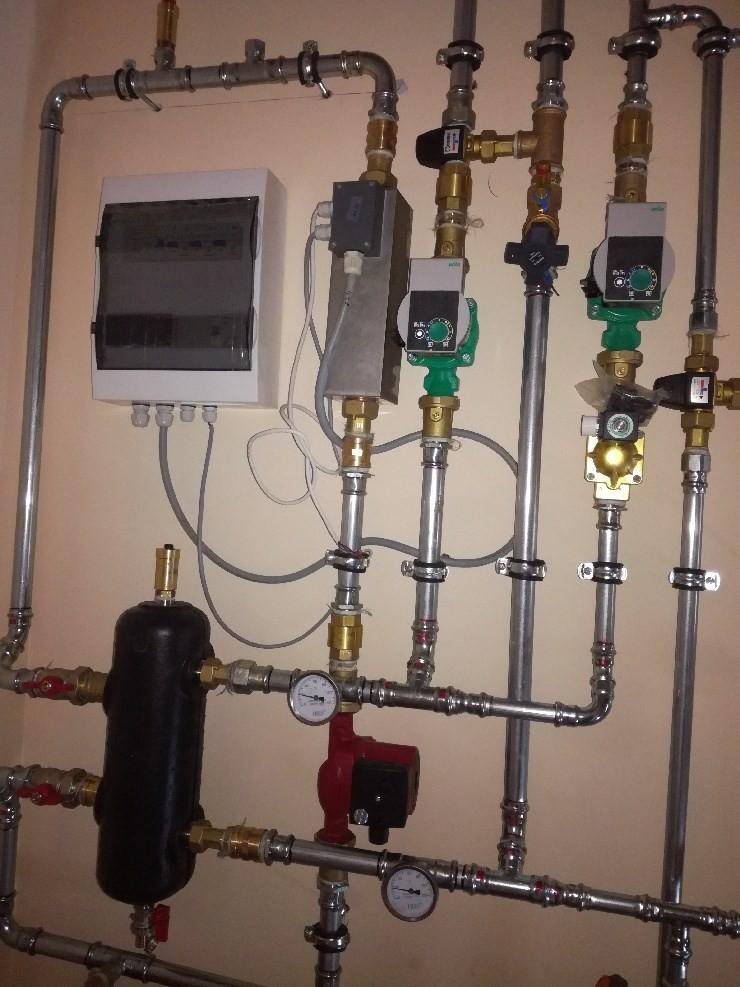
The heating module heats the water circulating in your heating system – exactly as your gas boiler did before. That is why your existing water-based system can often stay in place.
What stays?
The radiators, the underfloor heating, the pipes in the walls and floor. Only the old heat source is replaced by an electric module.
In a new build
The system can be designed from the start so that no gas connection, chimney or separate boiler room is needed. It can fit behind a 17–21 cm deep plasterboard wall, pump included.
Domestic hot water
A smaller indirect cylinder is enough: it refills quickly, and the module works in the closed heating circuit, so there is no limescale on the heating surface.
What the set contains – and what it does not
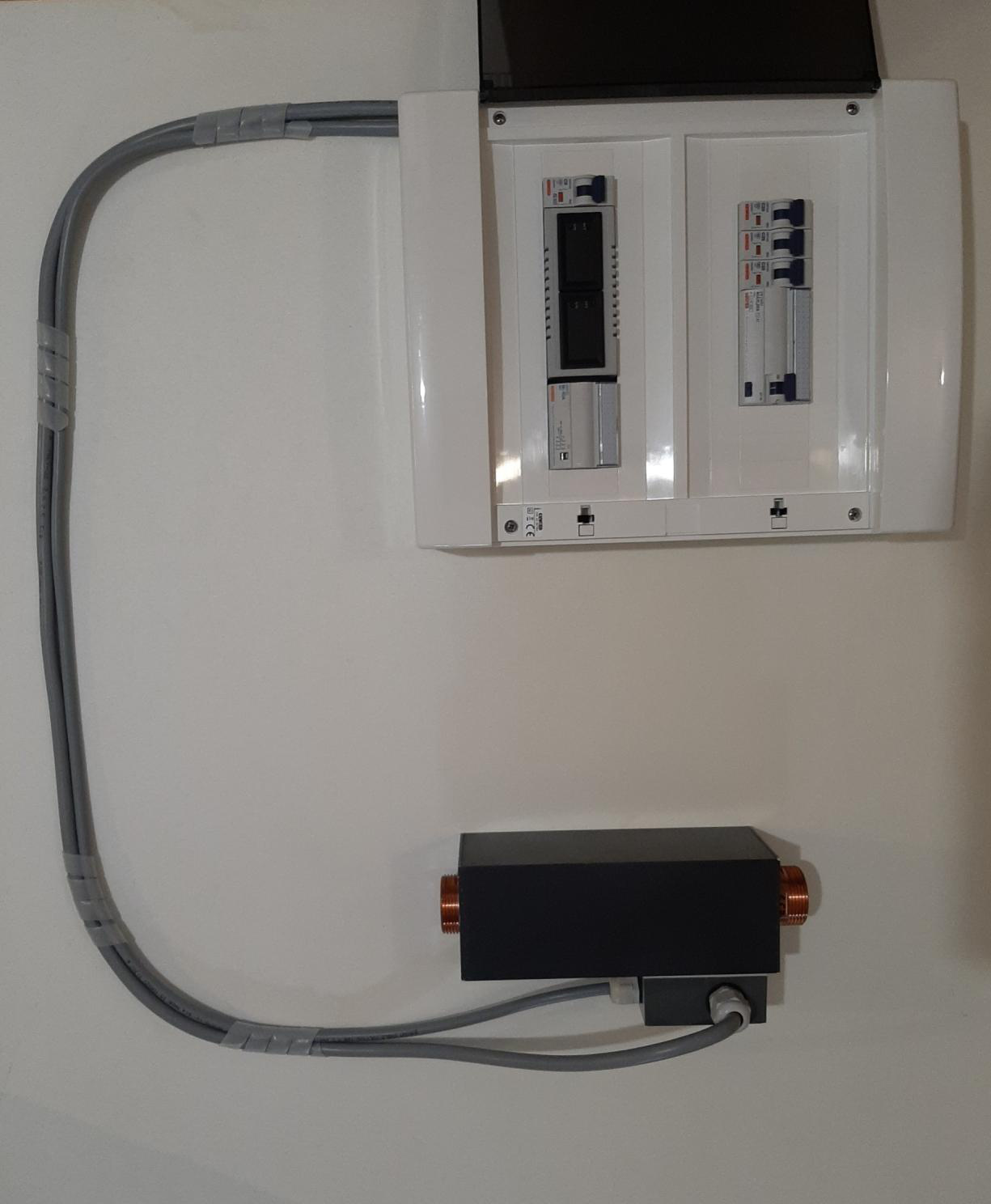
The set: heating module with flow-water sensors, distribution box with factory-fitted controller (two displays, fuses), documents (installation instructions, user manual, warranty certificate).
Not included: 2 × ball valve and 2 × union nut 6/4", 2.5 bar safety valve, expansion vessel, circulation pump (min. 800 l/h), flow switch, air vents, magnetic dirt separator (mandatory with iron pipework), Y-strainer. A 3-way valve and an indirect DHW cylinder are available on request.
What would you compare it with? Pick one.
Where the heating module is better
- No chimney, no gas connection, no flue gas – no permit required
- A fraction of the space: an 80×80 mm unit instead of a wall-mounted gas boiler
- No chimney inspection, no mandatory annual gas appliance check
- No risk of carbon monoxide or gas leaks
- Existing radiators and underfloor heating can stay
- With solar, your own generation goes straight into heating
- Can be run more cheaply on off-peak (night) electricity
Where it isn’t – and what to weigh up
- In many markets gas is cheaper per kWh than electricity. Whether switching pays off is decided by local energy prices.
- A higher electrical connection capacity is needed – the supply may have to be upgraded.
- If your gas boiler runs reliably and no major repair is due, replacing it may not be worth it yet.
Where the heating module is better
- A conventional element-type boiler typically lasts 5–8 years; the module is designed for at least 25
- No limescale on the heating surface, so efficiency doesn’t decline over the years
- According to the manufacturer it works at 175–500 W/cm² (heating elements: 5–13 W/cm²)
- Smaller, and heats up faster
- Efficiency: 99.4–99.7% (measured by an accredited laboratory, see below)
Where it isn’t – and what to weigh up
- The purchase price is higher than for a simple electric boiler.
- Electricity consumption is of a similar order; the payback comes from the longer life and the replacements you avoid.
Where the heating module is better
- Much lower investment and installation cost
- No outdoor unit, compressor, fan or refrigerant
- No mandatory annual service
- Less installed power is enough for the same job (the manufacturer’s experience: typically an 8 kW module instead of a 12 kW heat pump)
Where it isn’t – and what to weigh up
- A heat pump has a COP above 1, i.e. it makes heat from less electricity. The heating module has no COP: 1 kW of electricity gives 1 kW of heat.
- It cannot cool.
- The annual electricity cost may be lower with a heat pump – always work out the total cost over 25 years.
The comparison is general. The calculator and a personal consultation work from your own building.
A cheap appliance doesn’t cost money once. It costs it 4–5 times.
Installation costs roughly the same in both cases. The difference is how many times you have to pay for it – and that once the warranty runs out, repairs are no longer a one-off item but a running cost.
Conventional electric boiler (€500–1,000, service life 5–8 years)
Heating module (min. 25-year design life, 20-year replacement warranty)
25-year investment and maintenance cost – example for a 200 m² house, 12 kW module
| Item (gross, €) | Heating module | Heat pump | Premium gas boiler |
|---|---|---|---|
| Appliance price | 3,200 | 7,800 | 5,850 |
| Installation | 1,000 | 7,000 | 2,000–4,000 |
| Mandatory annual service | 0 | 200/yr | 50–110/yr |
| Repair, maintenance (every 3 years) | 0 | 500 | 300–800 |
| Main unit replacement after 15 years | – | 5,000 | 3,000–5,000 |
| Estimated total over 25 years | ≈ 4,200 | ≈ 28,000 | ≈ 14,850 |
Important: this table compares investment, installation and maintenance costs and does not include energy costs. According to the manufacturer the monthly electricity bill may be similar to or slightly higher than with the other two solutions. Manufacturer’s example calculation; prices vary by country and project.
And not only because you buy it less often
Efficiency tells you how much of the electricity you feed in actually becomes heat. Because there is nothing for limescale to settle on, the manufacturer states this figure does not deteriorate over the years.
Measurement and certification
According to the manufacturer, efficiency was measured by an accredited test laboratory in Brno (Strojírenský zkušební ústav, accreditation No. 1045.1) under Regulation (EU) 813/2013, using the ČSN EN 15502-1:2022 method (O-B-01059-23, 2023).
Safety compliance is certified by TÜV Rheinland InterCert Kft. (MN 69266874 0001, 2023).
[Copies of the certificates must be obtained from the manufacturer before publication.]
It doesn’t work in a brochure. It works in real buildings.
According to the manufacturer, the product is used in 17 countries at more than 2,000 private, commercial and industrial sites.
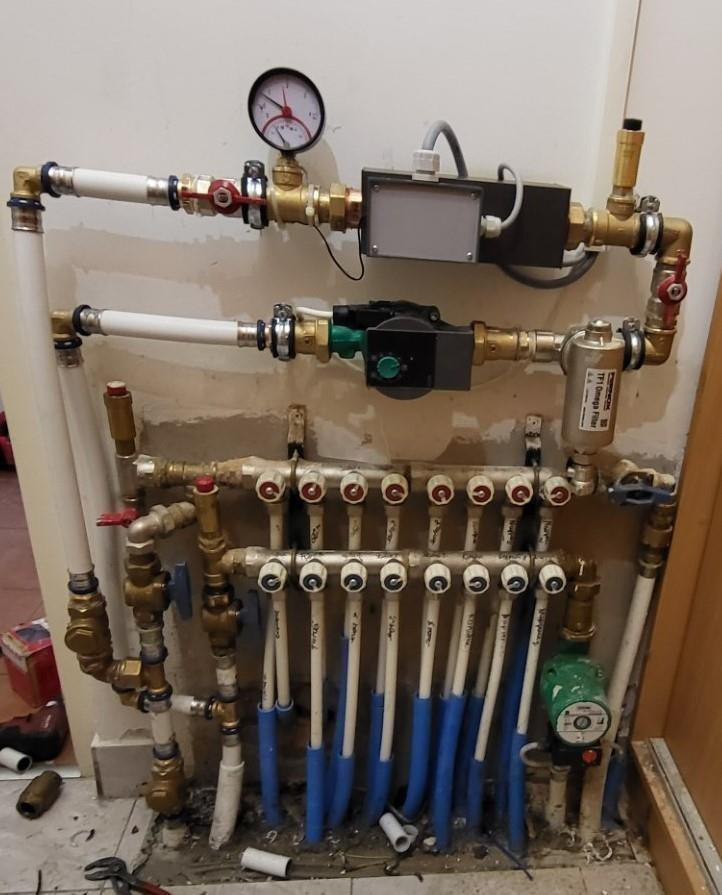
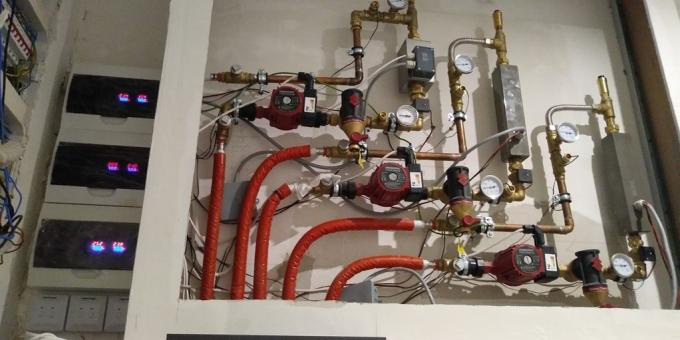
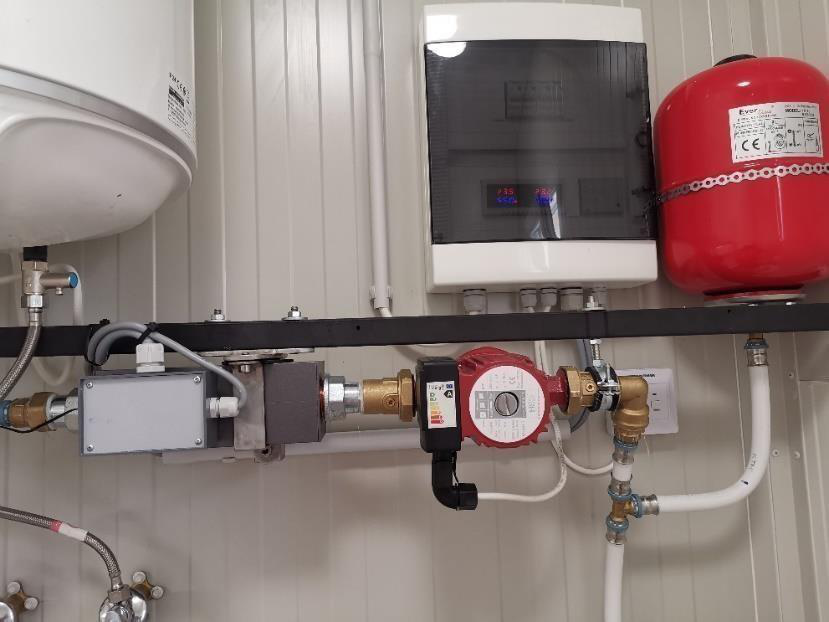
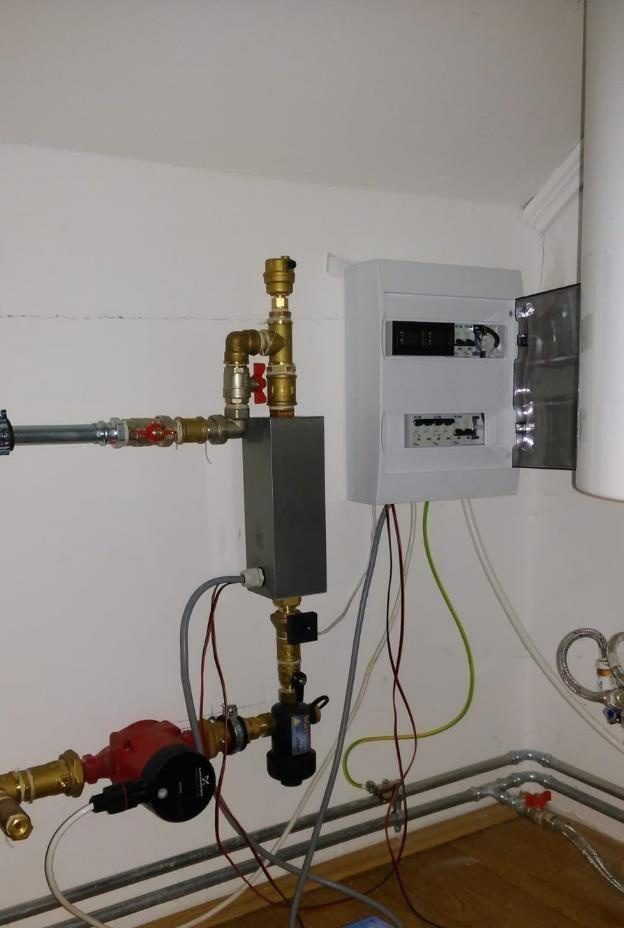
Examples (manufacturer’s references)
- 170 m² detached house, heating and domestic hot water – 12 kW
- 58 m² city-centre flat – 4 kW
- Detached house with wall and underfloor heating and hot water – 10 kW
- Four-apartment condominium – 4×4 kW, 138 m² in total
Homes
Detached and terraced houses, flats, holiday homes, rentals. Individual heat generation with no shared chimney or gas network.
Accommodation, hospitality, wellness
Hotels, guesthouses, restaurants, pool water heating via a plate heat exchanger.
Offices, retail, public buildings
Offices, shops, nurseries, schools, surgeries, community centres.
Industrial, agricultural
Workshops, plants, warehouses, greenhouses, polytunnels, process hot water. Several modules in parallel.
Hybrid and supplementary
Alongside solar, alongside a heat pump for the coldest days, next to a gas or solid-fuel boiler.
Minimum 25-year design life, 20-year replacement warranty
Protection on 2 levels
The manufacturer’s warranty comes on top of your statutory consumer rights – not instead of them, and without limiting them.
Few points of failure
The main unit contains no moving wear parts: no compressor, no fan and no other component under constant mechanical load.
No hidden exclusions
Before you buy, we show you what the warranty covers and which component we cannot offer the same on.
*The 20-year replacement warranty applies under the manufacturer’s conditions and with careful operation. [The exact warranty terms and the warranty registration link must be agreed with the manufacturer.]
It isn’t the right choice for everyone. We would rather say so up front.
It’s for you if…
- you are building or fully renovating right now
- you are facing the replacement of an ageing boiler
- you have a water-based radiator or underfloor heating system
- you are short of space and don’t want a separate boiler room
- you’d like to be rid of the chimney, the gas connection and the permits that go with them
- you are planning for the long term, and the lowest purchase price isn’t your main criterion
It isn’t for you if…
- your current boiler runs reliably and no major repair or renovation is due
- you get gas at a particularly good price, and switching wouldn’t pay off at local energy prices
- you also expect cooling from the system – the heating module does not cool
- your electrical supply cannot be upgraded to the required capacity
- the building’s heat loss is so high that insulating it first makes more sense
Only someone who will still be here in 20 years can give a 20-year warranty
The product is developed and manufactured by the Hungarian company DM-Horizont Kft. (according to the manufacturer, a family-owned business trading since 1997). [The distributor’s own introduction and description of its relationship with the manufacturer goes here.]
We distribute the manufacturer’s product. We are not a design office: what we provide is the appliance, the technical data needed for sizing, and a well-founded estimate of which output suits your building. The detailed design and the installation are done by your own designer and contractor – and we give them all the documentation they need.
Which output is right for you?
A few questions about your building, and we’ll show which module could be an option. If you have existing gas or oil consumption figures, use them – they are the most accurate starting point.
An estimate, not a sizing calculation. We’ll get back to you with the precise calculation within 2 working days.
Frequently asked questions
Does the product have a COP value?
No – and neither does a gas boiler. The heating module is a flow-through system, so it is characterised by thermal efficiency, not COP (99.4–99.7% across 4–12 kW): 1 kW of electricity gives 1 kW of heat. The difference is heating density: according to the manufacturer, the specific heating output is about 30 times higher than a conventional heating element, so a lower-kW unit is enough to heat the same area.
Can it replace my existing gas boiler, and what size do I need?
According to the manufacturer’s experience, in 70–80% of cases a 20–24 kW gas boiler can be replaced by an 8 kW module. They recommend 4 kW for 1,000–1,500 m³ of gas a year, 6–8 kW for 2,000–2,800 m³ and 12 kW for 3,000–4,500 m³. Insulation and the type of heating system may change this; underfloor heating is more economical.
How long does installation take?
With careful preparation the manufacturer’s materials say it can take as little as 60 minutes. It needs electrical and plumbing work, which your own contractor carries out.
Is a permit required?
According to the manufacturer, installation needs no chimney and no gas permit. Always check local regulations and whether your electrical connection must be upgraded with your utility and contractor.
How is domestic hot water produced?
With an indirect cylinder (and a 3-way valve). Heating 100 litres of buffer water takes about 1.16 kW per 10 °C of rise per hour – ideally, without losses, a 4 kW module can raise it by ~34 °C and a 12 kW module by ~100 °C in an hour.
Is no maintenance needed?
The main unit has no moving or wearing parts. The other parts of the system (pump, filters, valves) need the usual checks.
Can it be used for cooling?
No, the heating module only heats.
Where can I buy it?
Ask for advice using the form below; ordering comes after the consultation. [The ordering method (web shop, contractor) must be filled in according to the distribution agreement.]
3 routes. Pick the one that’s yours.
All three start in the same place: we look at what the heating module can do in your situation. We don’t begin with a quote, but with advice.
I’m looking for heating for my home
Building, renovating or facing a boiler replacement? We’ll tell you which output could work and what it costs in total.
I’d work with it as a professional
Contractor, building services designer or architect? We’ll show you the technical background, the sizing guide and the documentation.
I’d distribute it as a partner
Referral programme, sales agent, reseller or exclusive national partner – we discuss the terms in person.
The consultation doesn’t commit you to buying. If we think another solution suits you better, we’ll say so honestly.